Showing posts with label Tangiers. Show all posts

Thursday, February 27, 2014

THE THURSDAY MARKET IN BNI AROUSS

The road to Bni Arouss with taxis crossing the condemned bridge

The Thursday Bni Arouss market (Khmis Bni Arouss) is worth the trip up into the Rif Mountains. From Tangiers, you start off on the highway or the old main road and end up on small secondary roads, which have seen better days. Cars play a game of chicken as to which one will go off the paved road into the rough shoulder. Along the way, you pass modest homes, swank palaces and even a garage for “exotic cars.” With that description, the garage owner was advertising that he serviced and repaired Porsche, Ferraris and other luxury sports cars. Exotic cars on bad road? Palaces in remote villages? You may wonder at the contradictions which have only one explanation, the drug trade. The Rif has the mysterious quality of the Bekaa Valley in Lebanon.—all is not what it seems--green hills and fat livestock.

Let me make it quite clear, my husband and I were there to buy vegetables at the market, not the local weed at a Bni Arouss café. You also wonder how we came to know about Bni Arouss, a place Garmina the GPS, had trouble finding. Garmina kept showing our SUV traveling cross country instead of on a proper road. The answer to your question is that our housekeeper is from the Bni Arouss tribe and she wanted us to experience what she considered the best Thursday market. History buffs will recall that the Bni Arouss tribe protected Moulay Ahmed El Raisuni known as the “sultan of the Mountains.” Raisuni became a player in the 1904 presidential elections when he kidnapped Ion Perdicaris, an American citizen.
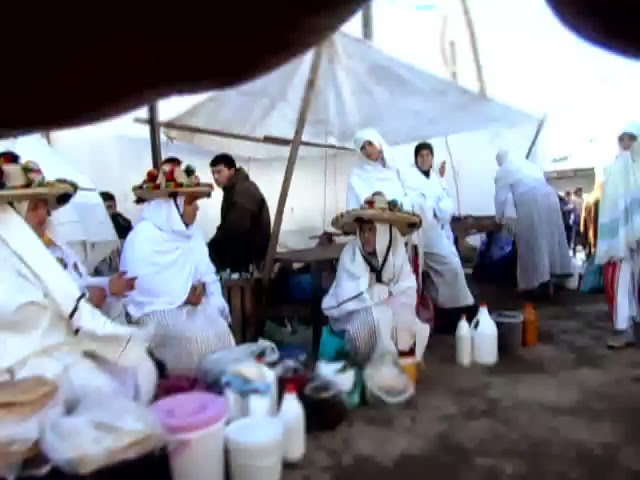

Bni Arouss ladies wearing their traditional clothes

On the way, we stopped for coffee at a truck stop featuring fava bean soup (bessara) for breakfast and fish brought from nearly Larache for lunch. It took us two hours to reach Bni Arouss. We parked the car on the main street, hired a car watcher and headed into the market. This market had it all—vegetables, fruit, household goods, hand woven djellabahs (the all-purpose hooded robe), handmade agricultural implements, sidesaddles for donkeys and my favorite item, real handicrafts from the region. We soon filled our three large bags with fruit and vegetables. We hired a porter with a wheel barrow when our arms grew too tired. Having filled the wheel barrow up, we went back to the car and launched into our second round. Then, my husband bought three hand carved wooden serving spoons for $2 dollars and received instructions on how to soak them so they would not crack. I bought the local hand woven cloth that the Rif women wear tied around their waist as an apron for a $6 dollars each. I also wanted to buy a characteristic straw hat from the Rif (shishia) but the price in the market was too high. The local ladies were asking $25, whereas the Tangiers price was $5. If my husband had bought one without me, the price would have been better. Once a foreigner appeared with him, the price jumped.

The mother of our housekeeper

When we returned to the car, our housekeeper’s mother was waiting for us with one other daughter. I complimented her on her shishia and she offered to give it to me. I insisted on paying for it and bought it at twice the going price. That was fine with me because the object was to give her some money in a way she would accept. She then said that she wanted to show us the local river and the broken bridge. So, she left her donkey in town and hopped into our car. She was a very agile woman, for someone who had raised eight children. She explained that the road stopped at the bridge and the only way to get to her village on the hill was to walk or ride a donkey. She pointed out her home, a whitewashed cottage with a red-tiled roof. I promised to visit her the next time we came to Bni Arouss. My husband prompted me to add “God willing” (Inch Allah.) Since I’m not sure that my donkey riding skills are up to the steep climb, I’ll walk there with her, Inch Allah.

Sunday, February 23, 2014

FURNISHING A RIAD IN TANGIERS

The central courtyard unfurnished

Furnishing a traditional Moroccan home (riad) in Tangiers requires area knowledge, cultural awareness and unassailable resilience. To set goals, benchmarks and schedules is a sure path to madness. The same goes for trying to achieve absolute authenticity. At first, the downstairs, where ornate plaster and intricate mosaics predominate, was to be “beldi.” (Beldi is a tricky Moroccan concept, which can mean antique and traditional as well as antiquated and rustic.) The upstairs was to be mixed. In the end, both floors turned out to be an eclectic mélange of new and old, cheap and expensive, Moroccan and foreign. To cite one example, the drapes, upholstery and carpets come from Morocco, the Middle East, Central Asia, India, and the United States. Some areas, such as the central courtyard are still awaiting an influx of inspiration and funds.

With unlimited funds, a local cabinet-maker would have carved the furniture and a local decorator would have produced a “beldi” look. With two retirees on a fixed income, alternate sources were in order. These sources were: Carved wood that did not fit the intended space recycled into furniture; items from second-hand shops and flea markets restored by the night watchman; furnishings from my husband’s apartment in Casablanca repurposed for the riad and new rustic furniture from outdoor markets used to meet immediate needs.

$1000 Table (Left) and $100 Table (Right)

To give an idea of prices, a new hand carved table for the Moroccan salon costs about $1,000. A second hand “mocharabiye” table from the flea market runs around $100, depending on one’s haggling skills. For drapes, a Tangiers decorator proposed raw silk from Spain at $50 a meter in colors of her choice. She came highly recommended because she does quality work and meets deadlines. However, with 11 ft. ceilings, her services would have consumed the entire decorating budget. Instead, double-width cotton in the colors of the stained glass windows fit the bill at $7 a meter. The fabric was from the wholesale fabric market in Casablanca (Derb Omar). A local upholsterer, found through a Muslim brother in the Tangiers Bird and Flower market, made the drapes. The upholsterer’s work was acceptable but his brother, the drape installer, was not up to the task. He sang in a cabaret at night and had trouble staying awake during the day. We loved his Arabic love songs but his brother had to rehang every curtain.

Tangiers has a whole gallery of second hand dealers (brocanteurs) on the Rue de Fez but the prices they set for foreigners are high. Casa Barata, also known as Souk Barata, the huge flea market in Tangiers, has some interesting items if you are willing to walk for miles to find them. The days, when beautiful English furniture sold off by expats wound up in Casa Barata, are long gone. A local brocanteur on Avenue Hassan II in Tangiers was the source of a Bavarian bone china dinner set. He had tempting French oak furniture and Art Deco pieces left over from the French Protectorate. However, it was tough to buy from him because he was seldom open. Sometimes, the old gent who parks the cars in front of his shop can find him. Ould Mina, the flea market in the Hay Hassani district of Casablanca, is open for business seven days a week. The dealers there buy out whole houses and sell for reasonable prices. By buying in bulk, shopping on weekdays, going with a Moroccan niece, dressing in an inexpensive djellabah, and opting for good rather than great pieces, I obtained better prices than most foreigners.


Cedar doors recycled into a desk

The carved wood pieces that did not fit the intended space were the most satisfying to design and commission. From a set of massive cedar doors meant for the entrance to the courtyard, a Casablanca cabinet-maker produced an executive desk and four square tables. From two cedar doors destined for the entrance to the Moroccan Salon, a cabinet maker in Tanjia al Balia, the neighborhood up the hill from the riad, made an armoire for the dining room.


Rustic furniture bought at an outdoor Market
Every open air market has simple unstained furniture in cheap local wood (bois rouge) for sale. This furniture came in handy when the first guests announced their imminent arrival. These items are a good example of the second meaning of the word “beldi”. We are replacing this country furniture as well as the mattresses, which my husband’s nephew bought for them. The mattresses felt as if they were made of Styrofoam. Maybe they were.


The Night Watchman who also paints and restores furniture

The color scheme for the Riad came from the primary colors in the stained glass windows and in the zellige. The walls initially were painted in “Stuc de Venise”, an elaborate paint job that produces a mottled Tadelakt effect and a shiny, mirrored surface. Unfortunately, Stuc de Venise is fragile. If it cracks, it cannot be patched. We then tried another Italian paint that imitates Tadelakt and that can be retouched without repainting the whole room. That turned out to be prohibitively expensive. As I write, we are still experimenting to find interesting paint for the walls at a reasonable price.

In conclusion, let me pass on a lesson I learned in buying appliances, large and small for the riad: In Morocco, it is best to pay a higher price for top of the line American, German or South Korean appliances from a chain store. We have used the Comptoir Metallurgique, Electroplanete and Marjane. In buying electric/electronic items, avoid big souks like Derb Ghalef in Casablanca and Casa Barata in Tangiers. At a chain store, you can get a warranty, by taking your receipt to a uniformed guard at the reception desk who will stamp it. Do not lose that warranty. We have repaired or returned almost every item we have bought. The worst offenders were the Chinese vacuum cleaner that did not aspirate and the French coffee pot that did not drip.